
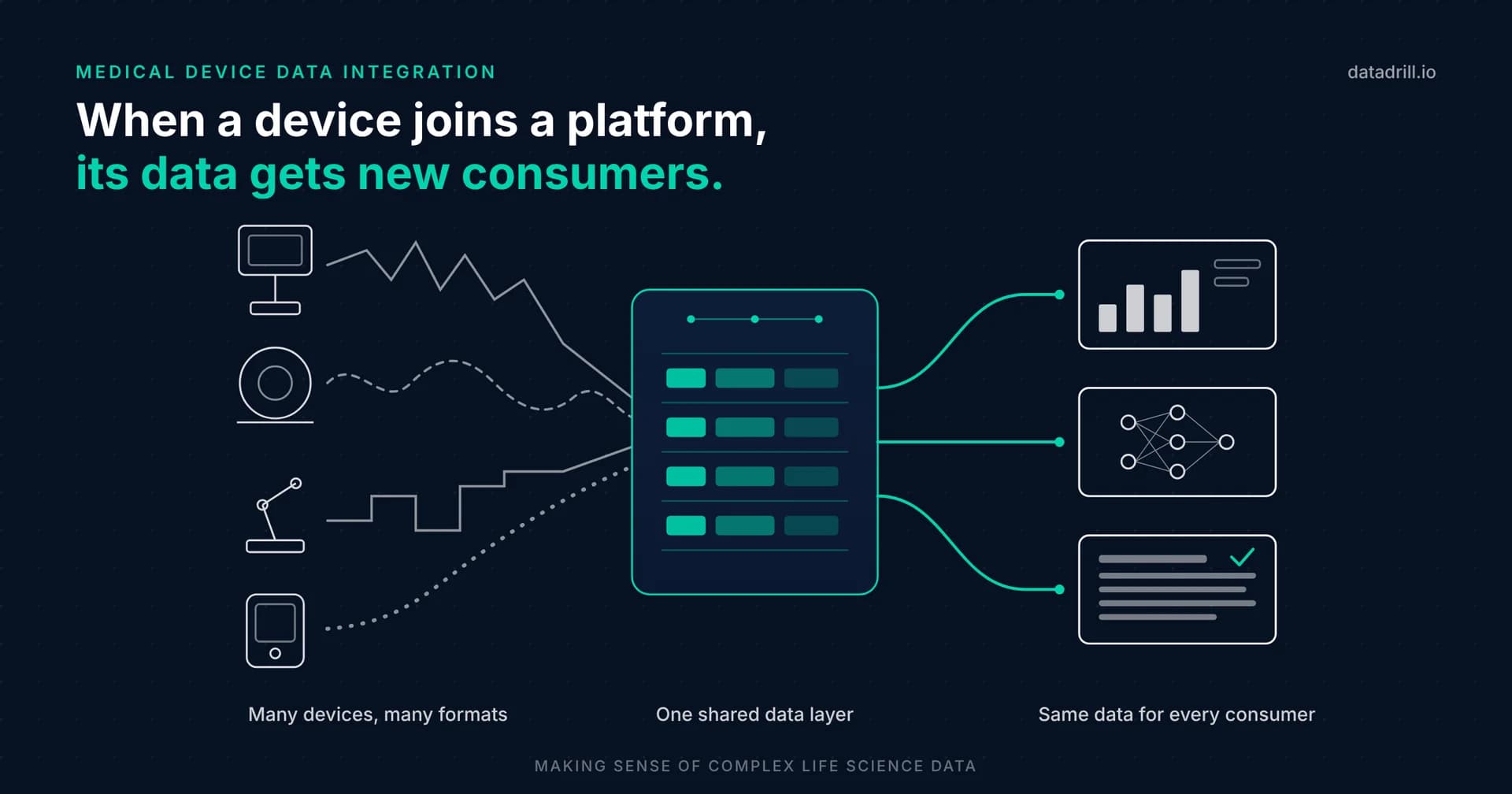
A medical device that ships on its own has one consumer for its data: its own software. Once that device becomes part of a platform, the same data gets several new consumers the device team never designed for: a fleet dashboard, a cloud workspace, another vendor's algorithm, a hospital's reporting system.
Medical device data integration is the work of serving all of them from one trusted layer. It is usually where a platform programme slows down, and the device itself is rarely the cause. The delay sits in the layer between the device, the cloud and other people's software.
What a platform asks of device data that a device never did
The direction is visible in public product announcements across imaging and surgery. Recent examples include a cloud application that brings transducer and system data from a connected ultrasound fleet into one operational view, a managed cloud service that orchestrates third-party imaging AI next to the maker's own visualization tools, and a surgical navigation system positioned as part of an ecosystem that connects technologies, data and workflows around the procedure.
Each of these changes who reads the data.
A fleet view compares utilization across sites, so every system has to report the same thing in the same way.
AI orchestration sends images to an outside algorithm, and the result has to come back and attach to the right study.
A procedure ecosystem joins data from before, during and after a case, so all of it has to describe the same case.
Regulators describe the same shift in their own terms. The FDA's guidance on interoperable devices notes that as devices connect to each other and to other technology, their ability "to safely and effectively exchange and use the information that has been exchanged becomes increasingly important". Exchange is the visible half. Use is where most of the data engineering sits.
Four data jobs the platform inherits
1. A data contract for every device generation
An installed base spans years of hardware and software versions. Field names, units, sampling rates and clock behaviour differ between generations, and sometimes between software releases of the same model.
A data contract states what each generation emits, in what shape, what counts as a valid record, and who approves a change. Without it, every new dashboard rediscovers the differences on its own, and each team resolves them slightly differently.
2. One identity model across device, site and case
Fleet questions join device records to locations, service history and usage. Clinical questions join them to a study or a procedure. Both depend on stable identities, and identities drift: devices move between sites, sites are renamed or merged, and accessories are swapped between systems.
Resolving those identities once, in one place, is ongoing engineering work. It is also the difference between a utilization figure people trust and one they recalculate in a spreadsheet.
3. A controlled route to and from third-party AI
The FDA's public list of AI-enabled medical devices runs to well over a thousand entries, so a platform that wants to offer outside algorithms has plenty to choose from. Each one is a new data consumer and a new data producer.
The platform has to know what left, in what form, which version of which algorithm processed it, and what came back. Standards work is moving in this direction. The IHE AI Results profile, currently in trial implementation, specifies how imaging analysis results are stored, retrieved and displayed. A standard for encoding results still leaves the platform to keep the record of which result came from where. We covered that record in more detail in our article on preserving lineage when external AI works on regulated data.
4. Two kinds of consumers with different tolerances
An operations dashboard can usually tolerate a record that arrives an hour late or gets corrected tomorrow. Anything that feeds a clinical report or a quality record typically cannot.
Both consumers read the same source data, so the practical pattern is one ingestion path with shared lineage and two delivery paths with different checks. Teams that build the dashboard path first and try to retrofit the stricter one later tend to end up maintaining two versions of the truth.
Signs that integration debt is already building
Each new dashboard or report needs its own extraction from the devices.
The same metric, such as utilization or procedure count, shows different values in two applications.
Adding a device model or a new modality means changing downstream code by hand.
Nobody can say which algorithm version produced a result shown six months ago.
Onboarding a new hospital takes longer than the one before it.
One engineer is the only person who understands the ingestion path.
None of these looks urgent on its own. Together they explain why the second and third application on a platform often cost more than the first.
What carries over from other data-heavy platforms
Our own production work sits on clinical, market access and operational data, not on device firmware or connectivity. The layer above the device, though, behaves like platforms we have built, and three lessons carry over.
Many sources, one schema. On a real-time market access analytics platform built for a global CRO, we unified 50+ national datasets into one schema, with a modular architecture that keeps governance central and allows regional customization. The platform serves 1,000+ users in 15+ countries, and manual data preparation was cut by over 60%. Device generations and hospital sites play the role that national datasets played there: many sources that describe the same thing differently. More detail is on our case studies page.
Contracts before pipelines. Outside life sciences, in a data platform industrialization for a global semiconductor technology company, the onboarding was contract-first: contracts, schemas and ingestion patterns were agreed with the producing teams before anything was built, and custom parsers handled the heterogeneous datasets that generic ingestion could not. Fifteen new datasets were industrialized this way. Device and instrument data could benefit from the same discipline.
AI depends on the curated layer. A domain-specific AI SQL agent we built for a global CRO's market access platform included seven purpose-built SQL views and took data coverage from 20 to 250+ fields. The model was not the hard part, a point we develop in The Agent Is Not the Hard Part. The Definitions Are.
A practical starting point for device platform teams
Start with a map, not a build. List which device generations emit what, which applications consume it, where third-party software enters and leaves, and who owns each definition. That landscape view usually shows one place where a contract or an identity model would remove the most repeated work.
Then take one defined workstream: a contract for one device family, or one identity model shared by two applications. This is the kind of work our data engineering team does, and it is small enough to prove the approach before the next modality arrives.
It also helps to decide early who owns the data layer once the platform is live. As we argued in why life sciences digital products lose momentum after launch, data and integrations become product responsibilities the day real users arrive.
Treat the data layer as part of the product
A platform adds value every time a new application can reuse what the last one needed. That only happens when device data arrives with a contract, a stable identity and a traceable history. Teams that plan this layer alongside the first application tend to find the later ones easier to add.
Questions teams ask next
Is medical device data integration the same as device interoperability?
No. Interoperability is the ability of devices and systems to exchange information and use it. Integration is the ongoing engineering that makes the exchanged data consistent, traceable and usable across applications, sites and partners.
Do standards such as DICOM and FHIR solve the problem?
They solve an important part of it: how images, results and clinical records are structured and moved. They do not decide your identity model, reconcile differences across an installed base, or record which algorithm version produced a result. For the standards side, see our FHIR guide for developers.