
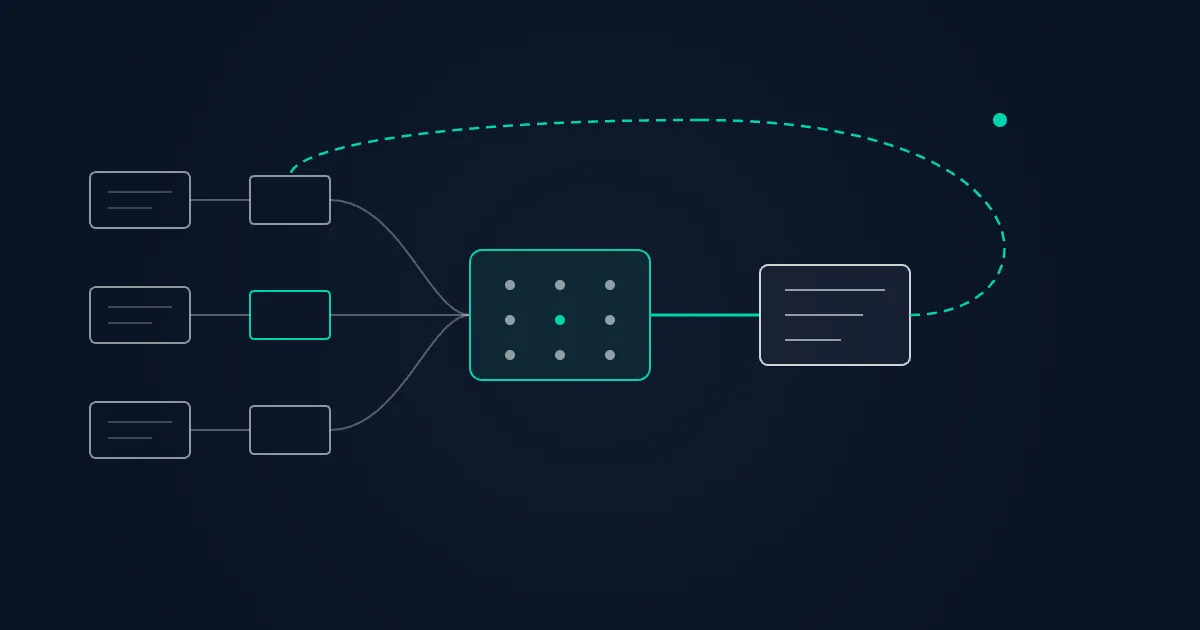
AI and data engineering in life sciences are not separate workstreams. An AI system can only be as dependable as the data path that supplies it, the controls that define its use, and the evidence used to evaluate it. In practice, production AI needs governed sources, repeatable transformations, clear ownership, access controls, versioned models, and monitoring after release. The model is one component inside that larger system.
This matters across discovery, clinical operations, safety, manufacturing, quality, and commercial analytics. Each area combines structured records with documents, changing definitions, restricted access, and decisions that must be explainable. A promising model does not remove that complexity. It makes the quality of the underlying engineering more visible.
Key Takeaways
Start with a defined workflow and context of use, not a model demonstration.
Treat source data, transformations, model inputs, outputs, and human review as one traceable system.
Separate experimental pipelines from controlled production pipelines.
Evaluate the complete workflow, including retrieval, data quality, human interaction, and failure handling.
Monitor both model performance and the data conditions that can change it.
Where AI and Data Engineering Meet
Data engineering makes information reliable enough to be used repeatedly. AI uses that information to classify, predict, retrieve, summarize, or recommend. The boundary between them is therefore practical rather than organizational.
Consider a system that summarizes study documents. The model may generate the summary, but data engineering determines which document version is available, whether access rules are preserved, how sections are extracted, what metadata travels with each passage, and whether the output can be traced back to its sources. If any of those steps fail, changing the model may not fix the result.
The same pattern applies to structured data. A prediction built on laboratory, operational, or commercial records depends on stable identifiers, consistent definitions, controlled transformations, and known update times. A model can process a table without understanding that two columns use different definitions for the same concept. The pipeline must resolve that meaning first.
Define the Context of Use Before Selecting the Model
The first engineering decision is not which model to use. It is what the system is allowed to do.
A useful context-of-use statement identifies:
the user and workflow;
the decision or task the system supports;
the data sources it may use;
the output it produces;
the human review required;
the consequences of a wrong, incomplete, or delayed output;
the conditions under which the system must abstain or escalate.
This scope controls the rest of the architecture. A search assistant that retrieves approved documents needs different evaluation, latency, and review controls from a model whose output contributes to an evidence package.
The joint principles for good AI practice in drug development published by the U.S. Food and Drug Administration and European Medicines Agency emphasize a clear context of use, data governance, documentation, risk-based performance assessment, and life-cycle management. Those are system requirements, not model features.
Build a Traceable Source-to-Output Path
A production AI workflow should make it possible to answer five questions:
Which source records or documents were available?
Which versions were used?
What transformations occurred before the model received them?
Which model, configuration, and prompt produced the output?
What review, approval, or downstream action followed?
That path should be captured automatically. Reconstructing it from notebooks, chat histories, and personal knowledge after a problem appears is not a control.
For structured data, the path usually includes ingestion, validation, normalization, business rules, feature or retrieval preparation, and a governed access layer. For documents, it includes document identity, version, extraction, section boundaries, metadata, chunking rules, retrieval results, and citations. In both cases, lineage needs to reach the output a user sees.
The NIST AI Risk Management Framework organizes AI risk work around govern, map, measure, and manage. Its core also treats risk management as continuous across the system lifecycle. That is a useful operating model for teams that need engineering controls to survive beyond a pilot.
Separate Experimentation From Production
Experiments benefit from speed. Production benefits from controlled change. Combining both in one environment creates avoidable risk.
A practical separation includes:
version-controlled pipeline and application code;
isolated development, test, and production environments;
approved data access for each environment;
reproducible builds and model configurations;
automated tests for transformations and interfaces;
controlled promotion between environments;
rollback procedures for code, data, prompts, and models.
This does not prevent iteration. It gives iteration a safe route into production.
The production boundary should also include external services. If a model or retrieval service is supplied by a third party, record the service version when available, the data sent to it, the output received, and the policy that permitted the call. External AI does not transfer accountability away from the organization using it.
Evaluate the Complete Workflow
Model accuracy alone is not enough. The system can fail even when the model performs as expected.
For a retrieval-based assistant, evaluation should test whether the correct documents were available, whether the right passages were retrieved, whether the answer stayed within those passages, whether citations resolve to the source, and whether restricted content remained restricted.
For a predictive system, evaluation should test data coverage, missingness, subgroup performance, calibration where relevant, sensitivity to data changes, and behavior when inputs fall outside the validated range.
For every workflow, include operational tests:
What happens when a source is late?
What happens when a schema changes?
What happens when retrieval returns conflicting evidence?
What happens when the model is uncertain?
Can a reviewer understand why the result appeared?
Can the system stop safely instead of producing a confident answer?
The European Medicines Agency's reflection paper on AI in the medicinal product lifecycle describes a risk-based approach across development, deployment, performance monitoring, and decommissioning. It also places responsibility on developers and applicants to ensure that algorithms, datasets, and processing pipelines are fit for purpose. The practical implication is clear: evaluation must cover the data and pipeline, not only the model.
Monitor Data and Performance After Release
Production changes even when model code does not. A source system adds a field. A document template changes. A terminology mapping is updated. User behavior shifts. A model provider releases a new version. Each change can alter results.
Monitoring should therefore cover:
source availability and freshness;
schema and distribution changes;
data-quality rules;
retrieval coverage and citation failures;
model output quality;
latency, cost, and error rates;
user corrections and escalations;
access and audit events.
Alerts need owners and response procedures. A dashboard that nobody is responsible for is only a record of failure.
A Practical Implementation Sequence
The safest route to production is a narrow, valuable workflow with measurable boundaries.
Start by defining one user, one task, and one approved set of sources. Map the current data path and identify the manual steps, missing ownership, and weak controls. Build the smallest governed pipeline that can support the workflow. Define a representative evaluation set before release. Add monitoring and an escalation path. Then expand only after the first path works reliably.
This sequence creates reusable infrastructure. The next use case can inherit identity, access, lineage, quality checks, deployment controls, and evaluation patterns instead of rebuilding them.
DataDrill's AI solutions for life sciences combine AI application engineering with governed data and production controls. Related guidance explains why healthcare AI pilots fail to scale and how a data lake supports AI-ready data.
Final Thought
AI creates value in life sciences when it becomes part of a reliable workflow, not when it produces an impressive isolated answer. Data engineering supplies the repeatability, context, access, and traceability that make that possible. Build those foundations with the model, and the result has a credible path from experiment to production.