
The first Horizon Europe health calls for 2027 open on 29 October 2026, with the first deadline on 17 February 2027, according to the Health Work Programme 2026-2027. Many consortia are forming right now, and most of them start with the science and the clinical partners.
If you read the 2027 topic texts closely, one pattern stands out. The data-heavy and AI-heavy topics rarely ask for a new algorithm. They ask consortia to show that the data exists, can be integrated, can be validated on independent data and can be reused after the project. That part of a proposal is often written last and staffed last, even though the topic text puts it at the centre.
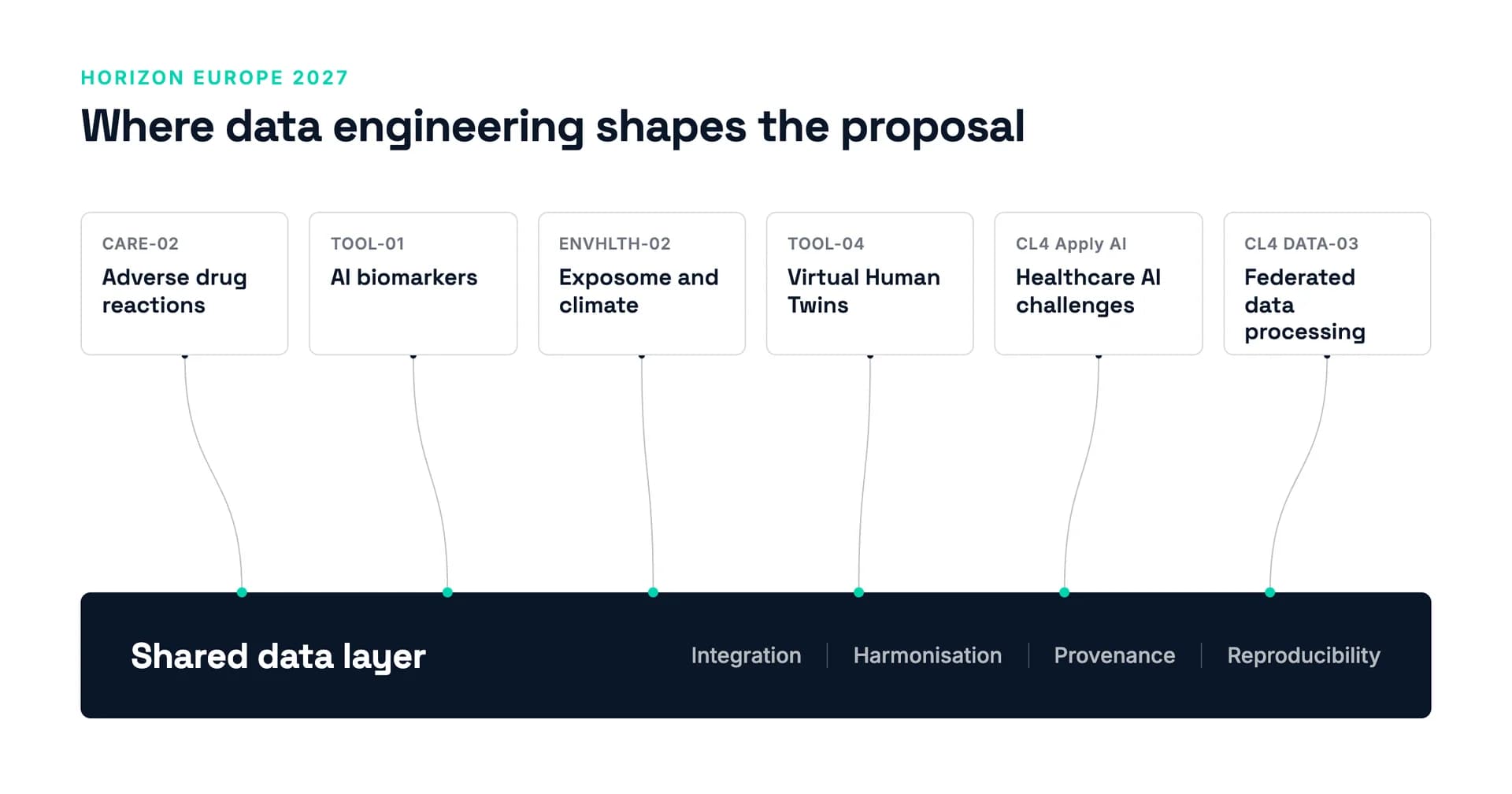
Below are six 2027 topics, in the Health cluster and in Cluster 4 (Digital), where the data and software work package decides much of what the proposal can credibly promise, and what a consortium should be ready to show for each one.
The 2027 Horizon Europe topics where data work carries the proposal
HORIZON-HLTH-2027-01-CARE-02: Personalised approaches to reduce adverse drug reactions when patients take multiple medicines. Data and AI ask: Data analytics integrated into electronic health records and clinical decision support; biomarker and genetic data brought into prescribing. Call window: Work Programme: opens 29 Oct 2026, deadline 17 Feb 2027 (see the note below).
HORIZON-HLTH-2027-02-TOOL-01: Predictive biomarkers for chronic non-communicable diseases, developed with AI. Data and AI ask: Established AI methods, proof that high-quality clinical data is available, real-world data integrated with clinical data, validation in independent cohorts. Call window: Two stages: 17 Feb 2027 and 16 Sep 2027.
HORIZON-HLTH-2027-01-ENVHLTH-02: Climate-related exposures and the human exposome. Data and AI ask: Integration of exposure, medical, omics and biological data in longitudinal cohorts; FAIR data; data sets uploaded to a shared catalogue; harmonised metrics. Call window: Opens 29 Oct 2026, deadline 17 Feb 2027.
HORIZON-HLTH-2027-03-TOOL-04: Virtual Human Twins for clinical decision support in prevention and diagnosis. Data and AI ask: Documented multimodal data availability and integration; assets interoperable with the EU Virtual Human Twins Platform; validation in real-world settings. Call window: Opens 3 Jun 2027, deadline 22 Sep 2027.
HORIZON-CL4-2027-04-DIGITAL-EMERGING-04: Apply AI: challenge-driven AI innovation booster, with healthcare as one of three sectors. Data and AI ask: Competing teams must have access to relevant data to fine-tune models; support for wide uptake of solutions. Call window: Opens 17 Nov 2026, deadline 18 Mar 2027.
HORIZON-CL4-2027-04-DATA-03: Decentralised, federated and sustainable AI data processing. Data and AI ask: Tools for data quality and distributed data management across sources, with privacy protection. Call window: Opens 17 Nov 2026, deadline 18 Mar 2027.
Dates come from the Health Work Programme and the Funding & Tenders portal as of 26 October 2026. For CARE-02, the portal entry currently shows a later window than the Work Programme, so check the topic page before you plan around a date.
Adverse drug reactions: the integration problem comes before the model
CARE-02 focuses on patients taking three or more medicines at the same time. The topic asks for health technologies and data analytics integrated into electronic health records and clinical decision support systems, and it names pharmacogenomics, drug-drug, drug-gene and drug-food interactions as areas to cover.
In practice, the information a risk model needs sits in different places. Prescriptions are in one system, dispensing in another, lab values in a third, and genetic results, if they exist, often in a separate research database. Each uses its own codes. A model that predicts adverse reactions is only as good as the medication history it actually sees, and in a multi-site project that history looks different at every hospital.
What a strong proposal can show: which sources each clinical site will contribute, how medications and lab results are mapped to a common terminology, what happens to records that do not map cleanly, and how the decision support tool gets its data during routine care, not only during the study.
AI biomarkers: the topic tells you not to build new AI
TOOL-01 is unusually direct. The scope asks consortia to adapt and apply "established AI methods rather than developing novel ones from scratch", to show that the appropriate high-quality clinical data is readily available, and to run clinical validation in independent disease cohorts.
That moves the hard work from the model to the data. Validating in an independent cohort means the same pipeline has to run on data collected by someone else, with different variable definitions, missing values and follow-up intervals. If harmonisation was done by hand in a notebook for the training cohort, it will be redone, slightly differently, for the validation cohort, and the results will not be comparable. We wrote about this pattern in why the model is the smallest problem in Horizon health AI projects.
What a strong proposal can show: a data availability statement per cohort, a harmonisation layer that is versioned and rerunnable, and performance metrics defined before the validation data arrives. Stage 1 proposals are short, but the topic asks applicants to demonstrate data availability, so it belongs in the first stage too.
Exposome and climate: a data platform problem inside a research topic
ENVHLTH-02 asks for longitudinal cohorts that combine individual exposome data with medical, omics and biological data. It asks for outcomes supported by FAIR data, for data sets to be uploaded to the IHEN Data Catalogue, and for standardised metrics so that disease burden is reported consistently across regions.
Linking a heat or air pollution signal to an individual health record is not a research question. It is an engineering task with real decisions: spatial and temporal resolution, how addresses or postcodes are pseudonymised before linkage, and how metadata is prepared so a catalogue can accept it. These choices determine what the scientists can analyse later. Our earlier article on why FAIR data is not the same as a data management plan covers the infrastructure side in more depth.
Virtual Human Twins: interoperability is written into the scope
TOOL-04 opens later, in June 2027, which makes it one of the few 2027 health topics where a consortium can still be designed around the data from the start. The scope asks consortia to document multimodal data availability and integration, to make project assets interoperable with the technical specifications of the EU Virtual Human Twins Platform, and to show clinically meaningful decision support in real-world settings.
Building to someone else's specification is a different job from building a research prototype. It means stable data contracts, versioned model inputs and pipelines that pull from hospital systems repeatedly, not once. We looked at the data layer behind twin models in building the data foundation for Virtual Human Twins.
Apply AI and federated data processing: the digital side of health
Two Cluster 4 topics are worth a look for health consortia. DIGITAL-EMERGING-04 runs challenge-driven competitions in three sectors, including healthcare, and the consortium must make sure competing teams have access to relevant data to fine-tune their models. Preparing curated, documented and access-controlled datasets for outside teams is a project in itself, and it has to be ready before the first challenge opens.
DATA-03 asks for new approaches to decentralised and federated AI data processing, including tools that keep data quality consistent across distributed sources and protect privacy. Health data is one of the most obvious domains where data cannot be moved freely, so health use cases fit naturally here.
Five things to have ready before you write the data work package
A data inventory per partner. What exists, in which format, how much of it, and who approves access.
A harmonisation plan. The target model or terminology, and the rule for records that do not map. Flag them; do not silently drop them.
Provenance. A way to trace every result back to the source records and the version of the pipeline that produced it.
Reproducibility. Versioned data and pipelines that can rerun on a new cohort or a new site without manual rework.
A realistic effort split. Person-months for data integration and pipelines, not only for modelling and analysis.
This is the same discipline we apply outside Horizon. On a data platform modernisation beneath a global CRO's live market access platform, 100% of 38,571 pricing presentations were migrated, up from 61.7%, and the records that could not be resolved were carried as free text and flagged rather than dropped (see the case). On an AI engine that predicts and consolidates the PICOs European health systems ask for, every consolidated PICO keeps full provenance back to its source (see the case).
A practical starting point for consortia still shaping their data work package
If you are coordinating or joining a consortium for one of these topics and the data and software work package is still open, that is where we usually contribute: data engineering for life sciences, the platform the data runs on, and AI and machine learning built on top of it. DataDrill is based in Novi Sad, and Serbia is one of the countries associated to Horizon Europe.
The 2027 topics reward consortia that can show their data is real, connected and reusable. Science still wins proposals, but in these topics the data work package is what makes the science look deliverable.